
Feuding With A Ghost
On why George Takei grudging with the ghost of 1967 William Shatner is embarrassing instead of empowering.

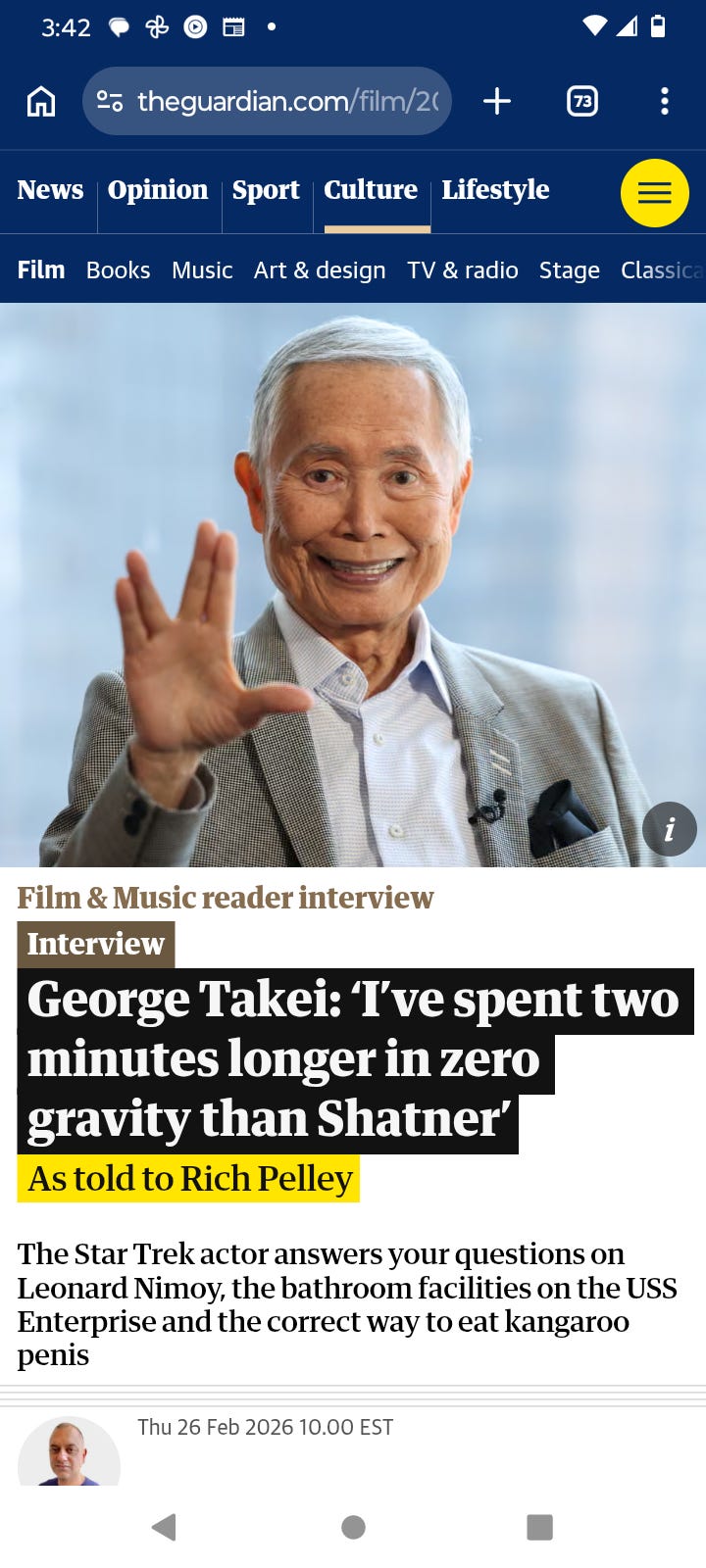
George Takei gave an interview to The Guardian recently. The headline they ran with? "I've spent two minutes longer in zero gravity than Shatner." That's the pull quote. That's what they led with. And honestly, who can blame the editors, it's punchy, it's quotable, and it's exactly the kind of thing that gets clicks. But when you sit with it for a moment, something starts to feel off. Not offensive. Just sad and a little pathetic.
I want to like George Takei. That matters here, because this isn't coming from a place of hostility toward the man. He survived Japanese American internment as a child. He came out publicly at a time when that still carried real professional cost. He used social media with genuine wit and built a second act as an LGBTQ+ activist that reached millions of people who otherwise might never have engaged with those issues. He's a regular on Howard Stern. By any fair accounting, George Takei has lived a remarkable and meaningful life.
And yet. Every interview. Every appearance. Every opportunity handed to him by a journalist who knows the bit by now, there's William Shatner's name, and there's the venom.
The zero gravity line is a perfect example of the pattern. Shatner, at 90 years old, rode a Blue Origin rocket to the edge of space. When he came back down, he was visibly shaken, not in a performing-for-cameras way, but in the way of a very old man who had just been cracked open by something immense and true. He spoke about the fragility of the atmosphere, about the thinness of the blue line separating all life from the void. It was, whatever you think of Jeff Bezos's vanity project, a genuinely moving moment. Takei's response was to point out that he'd done two extra minutes of weightlessness on a parabolic flight in Vegas. Something that, for context, any civilian can pay to experience.
It's not that the joke isn't clever. It is, sort of. It's that the joke required him to be paying close enough attention to Shatner's life to immediately have a comeback ready. That's not indifference. That's the opposite of indifference. That's a man who has been keeping score for sixty years.
Here's the thing about the score, though, Takei is not some failure who had his career pulled out from under him because Shatner stole a handful of his lines. He just doesn't seem to know that.
Sulu was not a throwaway character. He had the helm of the most famous ship in the history of science fiction. He had plots, he had swordfights, he had the kind of quiet dignity that made him genuinely iconic. He got a command of his own in The Undiscovered Country. John Cho played him in three blockbuster films for a whole new generation. There are Asian American actors working today who will tell you, without prompting, that seeing Sulu on that bridge as children changed something in them about what was possible. The character landed. The legacy is real and it is significant.
So what, exactly, is the grievance? Because if it's personal, Shatner was dismissive, Shatner was difficult, Shatner's ego filled every room he walked into and left the supporting cast standing in the hallway, okay. Those things sting. They're real. Nobody is obligated to pretend that professional slights didn't happen. But there's a meaningful difference between acknowledging harm done to you six decades ago and constructing an entire public identity around it. At some point, performing the wound stops being honesty and starts being a habit. A bit. A reliable applause line that journalists have learned they can always get. Takei holds onto that grudge harder than I hold on to the people who I love.
And what troubles me about that is the William Shatner that Takei is feuding with hasn't existed for over half a century.
People change. This is not some controversial observation. Takei himself would be the first to agree, the man he is now, flamboyant and boisterous, is almost unrecognizable from the demure, closeted young actor navigating a television set in 1967. He knows what transformation looks like because he's lived one. But the Shatner in Takei's public narrative is frozen. He's the egomaniacal lead actor on a 1960s soundstage, hogging camera angles and taking up all the oxygen. That man, if he ever fully existed, is gone. The one who replaced him is 94 years old, has buried a wife, has spoken openly and movingly about mortality, and wept at the edge of space. That William Shatner has never once been given the chance to be anything different in Takei's accounting, because Takei has never spoken to him, only about him.
That's not a feud. That's a haunting.
There's also a debt worth naming, because I think it gets obscured in all the sniping. Shatner had a career before Star Trek and demonstrably rebuilt one after, TJ Hooker, The Practice, Boston Legal, a spoken word album that became a genuine cult object, a late-period reinvention that would have been a full career for most people. He has a floor that exists independently of the franchise. For Takei, as for most of the supporting cast, Trek is the floor. It's not a knock on any of them, it's just reality. Without Star Trek, Takei is a working actor with a modest résumé. Or worse, just some old Japanese guy saying “Yeah, I tried acting when I was younger. Didn't work out.” Without Star Trek, his second act as an activist doesn't get any oxygen either. "Star Trek Actor Performs Activism" is a headline. "Some Guy Is Activist" is not. The platform he uses to reach millions of people on issues he genuinely cares about exists because William Shatner was the star who got that show greenlit, kept it alive, and carried it through three seasons and six films. Whatever happened between them personally, that foundation was laid by someone else.
I've been thinking about this through the lens of recovery, which is the framework I find myself reaching for more and more when I'm trying to understand why people do the things they do. One of the core ideas in that world is the distinction between acknowledging what was done to you and building a permanent residence in it. Resentment, the thinking goes, punishes the person carrying it far more than the person it's aimed at. And the particular cruelty of public resentment, the kind performed for journalists and audiences, is that it keeps you locked in relationship with the very person you claim to want free of. Every Shatner dig re-centers Shatner. Every interview question Takei answers with a zinger makes him the moon to Shatner's planet. He keeps giving the man gravitational pull.
Shatner was reportedly difficult. He was probably selfish in the particular way that leading men of that era were permitted and even encouraged to be selfish. He may well owe George Takei a genuine apology for things that happened sixty years ago on a television set. I don't know. What I do know is that for the punishment Takei has been publicly meting out to match the crime, Shatner would have had to do something considerably more serious than hog camera angles and skip a wedding invitation. He'd have had to go through that City On The Edge Of Forever time portal and personally have interred Takei and his family in the 1940s.
I want to like George Takei. And I do, in the abstract, in the outline of what his life represents, in what Hikaru Sulu meant and still means. But there's a version of this man who could have been genuinely gracious, who could have said, here is the complicated person I worked with, here is what was hard, here is what I built from it, and here is why it was all worth it, but now I've gotten the poison out, I'm going to drop it. That version would have been formidable. Instead, every few months, there's another headline. Another zinger. Another two minutes in zero gravity.
It's not a good look. More than that, it's a waste of a genuinely remarkable life. And the saddest part is that he doesn't seem to know it.